
Solid Hardwood vs Engineered Hardwood: Which Is Better?

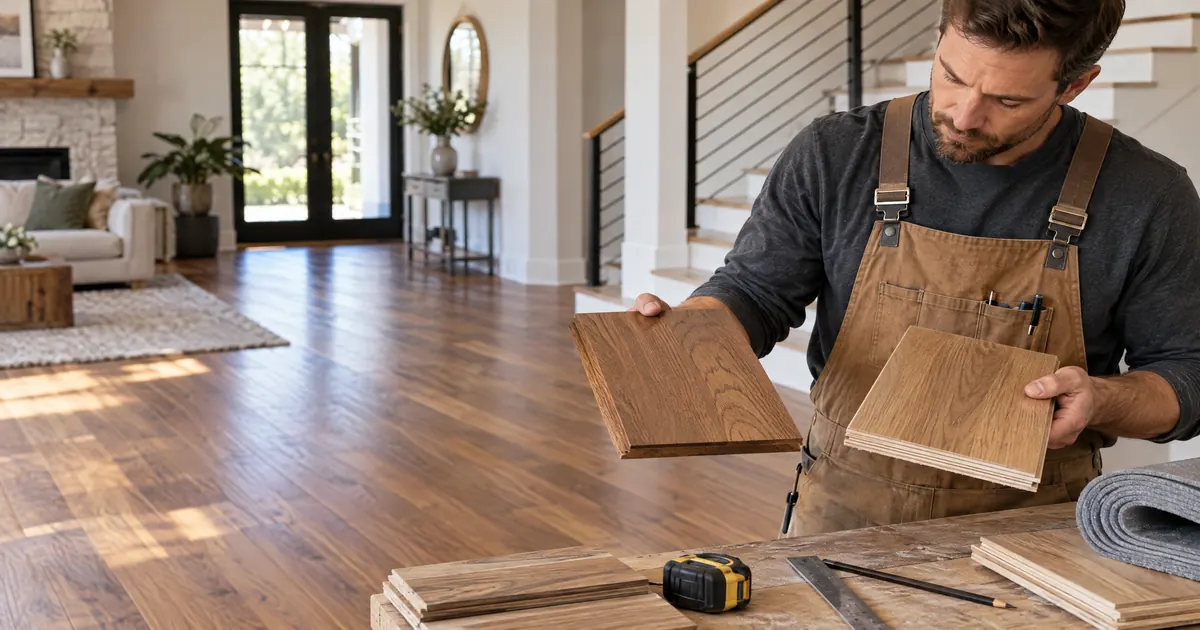
Walk into almost any well-designed home, and there is a good chance the floors are hardwood. Real wood flooring has a warmth, depth, and character that no synthetic material has fully replicated. But once you have made the decision to install hardwood, you face a second choice that trips up a lot of homeowners: solid hardwood or engineered hardwood?
The debate of solid hardwood vs engineered hardwood is not about which is more beautiful. At a glance, the two can look virtually identical. The difference is in the construction, and that construction determines how each type performs in your specific home, under your specific conditions. Getting this decision right has consequences that will play out for decades.
What Solid Hardwood Actually Is
Solid hardwood is exactly what it sounds like: each plank is a single, solid piece of wood from top to bottom, typically three-quarters of an inch thick. Popular domestic species include oak, maple, and hickory. With proper care, solid hardwood floors can last up to 100 years and be refinished four to six times over their lifespan. That refinishing capacity is one of solid hardwood’s most significant advantages. Every sanding removes a small layer of wood, so the thicker the plank, the more opportunities you have to restore the surface and refresh the look.
The limitation of solid hardwood is moisture. Natural wood is porous and sensitive to humidity and temperature fluctuations. It expands in humid conditions and contracts when dry. This movement is normal and manageable in stable, dry environments. But in spaces with meaningful moisture variation- basements, kitchens, coastal properties- it can cause gaps, cupping, or warping. Solid hardwood is best suited to above-grade living areas with consistent climate control.
What Engineered Hardwood Actually Is
Engineered hardwood is also 100 percent real wood. The distinction from solid hardwood lies in the construction. Each engineered plank has a top veneer layer of real hardwood bonded to a core of high-density fiberboard or cross-ply plywood. That multi-layer, cross-ply construction gives engineered wood significantly better dimensional stability. It resists the expansion and contraction that solid hardwood undergoes with humidity change, which is why it performs in environments where solid hardwood struggles.
Engineered hardwood can be installed over concrete subfloors, over radiant heat systems, and in below-grade spaces where moisture variation is a real factor. The trade-off is refinishing capacity. Depending on the thickness of the top veneer layer, engineered hardwood can typically be refinished once or twice, with thin veneers sometimes offering no refinishing capacity at all. When choosing engineered hardwood, veneer thickness is one of the most important specifications to verify.
How They Compare: The Numbers That Matter
In the solid hardwood vs engineered hardwood comparison, longevity and cost are the two variables that generate the most questions. Solid hardwood can last up to 100 years with proper maintenance. Quality engineered hardwood typically has a lifespan of 25 to 40 years, depending on the veneer thickness and the quality of the core construction.
On cost, engineered hardwood is generally the more budget-friendly option. Engineered hardwood flooring typically starts around $4.50 per square foot for click-lock-style planks and runs to approximately $16 per square foot for premium products. Solid hardwood ranges from $5 to $28 per square foot, with prefinished solid hardwood generally in the $6 to $12 range. Installation of solid hardwood is also more labor-intensive, as it requires nail-down installation, which adds to the overall project cost.
Choosing Based on Your Home and Your Life
The right choice in the solid hardwood vs engineered hardwood question comes down to four practical considerations.
First, where is the floor being installed? If the answer is below grade, over a concrete slab, over radiant heat, or in a coastal property with meaningful humidity variation, engineered hardwood is the appropriate choice. If the installation is above grade in a climate-controlled living room or bedroom, solid hardwood is fully viable.
Second, how long do you plan to stay in the home? For a long-term or forever home where generational durability matters, solid hardwood’s 100-year lifespan and multiple refinishing opportunities are worth the premium. For a property where you expect to move within a decade, engineered hardwood delivers the same warmth and visual quality with meaningfully lower upfront cost.
Third, what are your moisture and climate conditions? In Charleston and the surrounding coastal islands, humidity variation is real and meaningful. For homes on Kiawah Island, Sullivan’s Island, or Daniel Island, engineered hardwood is often the more practically sensible specification, even in living areas, because coastal conditions affect how solid hardwood performs over time.
Finally, how important is refinishing to you? If you want the ability to refinish your floors repeatedly, perhaps changing the stain color or restoring a worn surface, solid hardwood is the only option that offers that flexibility across multiple generations.
A Decision Worth Making With an Expert
Flooring specification is a design decision, not a shopping decision. The material you choose underfoot shapes how every other element in the room reads and performs. Rose Ann Humphrey of Home Life specifies flooring as part of the full design direction of every project she leads, bringing decades of material expertise from New England and now applied throughout Charleston and the surrounding islands.
We want you to love the way you live, and we believe investing in the right material is among those first steps. Call Rose Ann today to learn more about which material to go for in your remodeling project.